
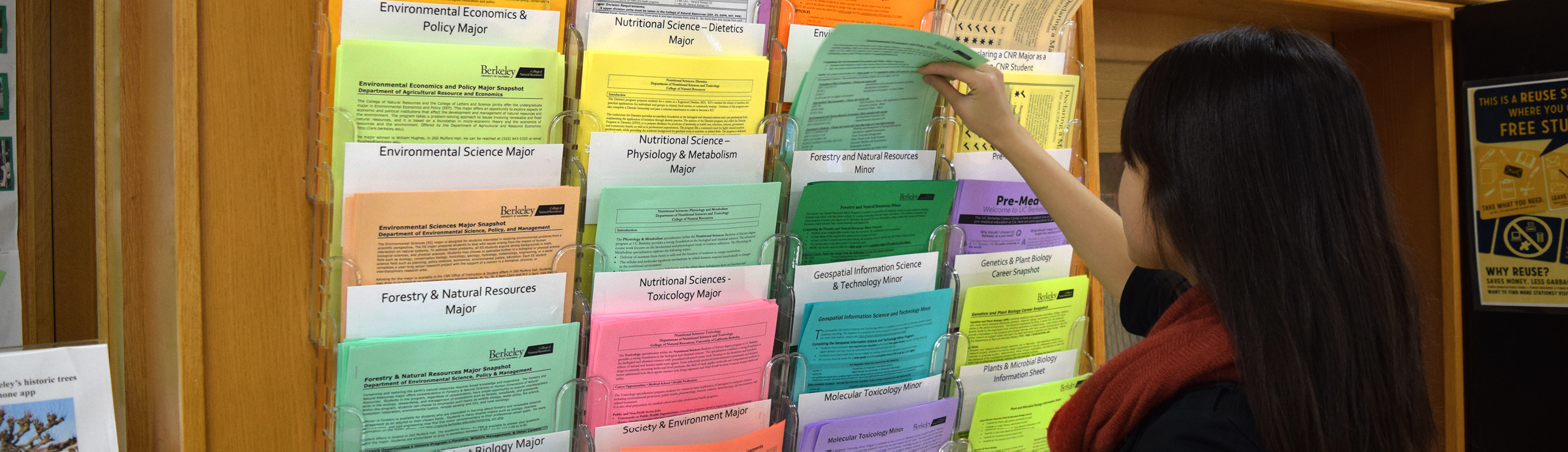
CNR offers five undergraduate minor programs spanning a range of biological, physical, and social science disciplines. If you would like to declare a minor in one of the areas listed below, please contact the Undergraduate Staff Advisor for the department offering the minor in which you are interested.
- Conservation and Resource Studies (CRS)
- Environmental Economics & Policy (EEP)
- Forestry and Natural Resources (FNR)
- Nutritional Sciences (NS)
- Toxicology
Minor in Conservation and Resource Studies
Conservation and Resource Studies is an interdisciplinary program designed for those who are interested in environmental issues and areas of interaction among natural resources, population, energy, technology, societal institutions, and cultural values. Students draw on the course offerings of the entire campus and appropriate community resources in the development of individual programs of study.
The CRS minor is oriented toward flexibility and an individualized educational approach to understanding the structure and dynamic functions of complex environmental systems within our society and biosphere. It encourages interaction among students, faculty, and community.
Requirements
- Complete a minimum of five courses related to Conservation and Resource Studies totaling a minimum of 12 units.
- One of the five courses must be ESPM 10, ESPM C10, ESPM C12, ESPM 50AC, or ES 10.
- At least three courses must be upper division.
- All courses must be taken for a letter grade and must average a minimum of 2.0 grade points overall.
How to Declare
Interested students should obtain the requirements from the department before starting the minor. Students will be awarded the minor following satisfactory completion of requirements and certification from the department. Offered by the Department of Environmental Science, Policy, and Management (ESPM).
Please see the CRS Undergraduate Advisor for more information.
Minor in Environmental Economics and Policy
Students may declare a minor in Environmental Economics and Policy as an adjunct to their chosen major field. This program offers interested students an opportunity to explore aspects of economic and political institutions that affect the development and management of natural resources and the environment.
Requirements
A minimum of six courses from the EEP curriculum is required. Please see the EEP Minor Requirements
for a complete list of acceptable classes.
How to Declare
Students should declare their intention to pursue a minor in Environmental Economics and Policy by contacting the EEP Undergraduate Staff Advisor. Students who believe they have already completed the requirements for the minor should see the Advisor for departmental certification. Please complete the EEP Minor Certificate
before making your appointment. Offered by the Department of Agricultural and Resource Economics (ARE).
Please see the EEP Undergraduate Advisor for more information.
Forestry and Natural Resources
A minor in Forestry and Natural Resources is for students who are interested in learning about these subjects as an adjunct to their chosen fields. Students in many diverse majors such as integrative biology, business administration, and civil engineering may find this minor complimentary to their professional career goals.
Requirements
- Complete a minimum of five courses related to Forestry and Natural Resources, totaling a minimum of 12 units.
- At least one course must be taken on the Berkeley campus (i.e., not all can be summer field program courses).
- All courses must be taken for a letter grade and must average a minimum 2.0 grade points overall.
- No more than one class from the Forestry minor may overlap with a course used to fulfill the student's major requirements.
How to Declare
Students who are interested must go to the department and obtain the requirements before starting the minor. Students will be awarded the minor following satisfactory completion of requirements and certification from the department. Offered by the Department of Environmental Science, Policy, and Management (ESPM).
Please see the FNR Undergraduate Advisor for more information.
Nutritional Science
The Department of Nutritional Science and Toxicology (NST) offers a minor in Nutritional Science. The course work for the minor addresses topics in Human Nutrition and Nutrient Function. Elective options range from Nuttition in the Community to Metabolic Regulation to Human Diet.
Requirements
- The Nutritional Science minor requires a minimum GPA of 2.5 and the completion of 15 units.
- The minor also requires Nutritional Science and Toxicology 10, 103, 160, and six additional elective units of upper division course work in the NST department.
- All courses must be taken on the Berkeley campus for a letter grade.
- No course substitutions are allowed.
Offered by the Department of Nutritional Science and Toxicology (NST).
How to Declare
Students apply for the minor during the semester they intend to graduate. Students will be awarded the minor following satisfactory completion of the course requirements.
Toxicology
The Department of Nutritional Science and Toxicology (NST) offers a minor in Toxicology. The course work for the minor addresses topics in the basic principles of toxicology and molecular toxicology as well as computational toxicology, pharmacology, and pesticide chemistry.
Requirements
- The Toxicology minor requires a minimum GPA of 2.5 and the completion of 15 units.
- The minor requires:
- NST 110, 120, 121
- NST C114 (same as ESPM 148)
- PH 172
- All courses must be taken on the Berkeley campus for a letter grade.
- No course substitutions are allowed.
How to Declare
Students apply for the minor during the semester they intend to graduate. Students will be awarded the minor following satisfactory completion of the course requirements. Offered by the Department of Nutritional Sciences and Toxicology (NST).

Students enjoy a stimulating learning environment at CNR.